The answer is an emphatic 'no' and you'll get the best results if you follow a few of my tips.
A recent staycation in the beautiful North Wales village of Portmeirion, made me realise you don't have to carry a boot load of camera gear to take decent pictures - the gallery below shows you just what I mean.
In my pocket was a tiny compact camera and the images were among the best I've taken on a holiday.
You can do the same with a bit of knowledge - read on to find out how.
(Click through the gallery below to see more of the beautiful Portmeirion Village in Gwynedd, North Wales)

Social media sites like Instagram where even amateur phootographers post incredible images of their travels means the pressure is on us pros to at least match that standard.
But if you're a professional photographer, taking a full camera kit away on holiday would be a pain in the rear end, not to mention making it more like work than relaxation.
So we can end up either not taking any pictures or using our smartphones to capture holiday memories.
(Not that there's anything wrong with using a smartphone - take a look at my pro tips for taking outdoor pictures with your mobile).
To get around this problem, a couple of years ago. I invested in a Sony compact camera and North Wales was my latest adventure with this pocket-sized piece of kit.
On previous holidays - a Norwegian fjords cruise in search of the Northern Lights and a trip of a lifetime around Australia, the camera had performed well.
Read on to find out how you too can capture your most memorable holiday pics without weighing yourself down.

Firstly that trip in search of the Northern Lights. Up on the deck of a ship in the middle of a Norwegian fjord at midnight, staring skywards, looking for a faint green haze is not easy. Once spotted, the aurora borealis may only offer you a few minutes to get your pictures.
Surrounded by hordes of amateur photographers with tripods, DSLRs and long lenses, I felt right out of place with that tiny Sony RX100 compact.
But I later realised that most were using an auto setting on their camera, which gave them an image pretty much the same as you could see with the human eye, just a small dim green haze in the sky.
Having done a bit of homework before the trip, I'd worked out the key to photographing the Northern Lights (or any night scenes) lies in the length of the exposure and the range of the ISO. In this case it was around 8 second exposure with 3,200 ISO and the lens wide open at F2.
All of these were settings that could have been easily replicated by the array of expensive cameras around me had the owners known how to switch to the M (manual) setting and take charge.
A small gorilla pod held down firmly to the deck of the ship by my hand meant I didn't need a large tripod and my Sony RX100 replaced my Nikon D5.SLR.
I was so impressed with the results from the little camera that the following year on a month-long trip to Australia once again I left the expensive gear at home and took the Sony, which made it feel more like a holiday and meant the whole kit fitted in my pocket.

So the message is you don’t always need super expensive kit to take decent pictures, what you need is an understanding of the basics, such as exposure, white balance and focussing.
Be brave and switch to manual (if your camera's instructions aren't enough for you, there are loads of YouTube videos explaining everything you need to know).
Here are my top tips on taking better holiday pictures :
1.If using your camera on manual, take a couple of shots of each view and alter the exposure for each one. This is called bracketing. You can do the same if your camera is on an Auto setting such as A,S or P by adjusting the exposure compensation dial. This will add or reduce the amount of light travelling through the lens, which will give you a variety of choices.
2. Watch out for messy backgrounds. Shifting your viewpoint slightly, such as shooting from a higher or lower angle can mean you avoid unwanted clutter in your pictures.
3. Don’t be afraid to shoot several images of the same scene, moving your position until it looks right through the viewfinder.
4. Set your focus on the main subject, but try to add depth to your images by using items in the foreground (such as tree branches). By doing this with a telephoto lens setting on your camera your subject will be sharp, but foreground and backgrounds slightly out of focus, creating more impact.
5. Try to add drama to your subject by altering the light. A flat grey sky will do little to bring your image alive, a dramatic sky, such the sun's rays peeping out from clouds or a full blown stormy sky will add far more impact.
Happy snapping - let me know how you get on by posting your comments below.
]]>
Gone are the days when professional photographers were the only people who'd carry a camera at all times - as many other have said, "We're all photojournalists now."
So whether it’s a breaking news story, such as a road traffic accident. or the flowers in your local park bursting out into the spring sunshine, we can all capture these moments and know how to take great photos on mobile phones.
In many cases grabbing the phone and pressing the button is all that’s needed. The phone's processor like Android's Octa core will look after the details like exposure, white balance, ISO and focus.
You you may ask why bother learning how to control these settings yourself? Read on to find out why (and browse the examples below, all shot outdoors on my Samsung Galaxy).

|
The answer to why you should look to control the settings yourself is simple.
Your brain is still better than any processor, and there are lots of times when the phone cannot possibly know what the subject matter is and the effect you're aiming to achieve.
For example, if you were photographing a fast-moving subject, by default the phone on an auto setting will choose a mid-range shutter speed of around 125th of a second.
While this sounds fast, it’s nowhere near fast enough to freeze a moving car or even a rugby player in full flight.
Getting to grips with the photo settings on your phone is not complicated, even though it might sound daunting.
Most handsets have a variety of modes, such as sport, night, portrait and so on.
But if you want to delve deeper into the technicalities and really make your photos stand out, then I advise adding specific apps to your phone. For Android, Camera FV-5 Lite is free and available from the Google Play Store, while iPhone users should look at ProCamera from the App Store (also free).

Both of these apps offer full control of every aspect of picture-taking on a mobile phone, including the settings I mentioned above and a whole lot more, such HDR and visual effects for smoothing skin and making your images pop.
The other advantage of using these apps is that it teaches you about the connection between shutter speeds and F Stops, all of which will stand you in good stead for graduating onto a compact or a DSLR /mirrorless camera.

Whilst you may not be impressed by a “pro” who’s cost a small fortune turning up to photograph your wedding with an iPhone, even the most serious photographer now recognises the role that a humble phone can play in achieving great images and videos.
Whether you're looking to take beautiful, professional-standard holiday pictures or capture a news story like the road accident at night (above), then the equipment you need is almost certainly with you all the time.
What's the most memorable scene you've caught on your mobile phone? And did it turn out as you expected? Add your comments!
]]>I left school with no qualifications, built a career in the business and I'm still enjoying paid work as a freelancer photographer based in Cardiff.
During my time as staff press photographer and picture editor I was responsible for taking on work experience candidates.. Over the 35 years as a staffer, I saw probably about a hundred or so people.
In that time only two (as far as I know) went on to have a full-time career in their chosen field of photography. Several did find jobs in the photography sector but not in the role they'd hoped for. What made those two stand out?

Looking at the two who did make it their career, I would say their qualities were:
-
They knew exactly what field of photography they wanted to work in and focussed only on that
-
They had mapped out their path to the end goal and done this well
-
They had high levels of technical and artistic skill
-
They were dedicated and now in their well-respected jobs are still committed

|
| Read my tips for taking pictures of royalty even if you're not a professional photographer |
When starting out on the road to being a pro here are some questions to ask yourself:
- Are my pictures any better than the average picture you see on Facebook or Instagram? If they're not then you'll need to bring them up to at least that standard
- Do I have a clear idea of which area of photography I'd like to work in? It's a very big subject with dozens of career paths, ranging from portraiture and weddings to forensic, with commercial, press, marketing, aerial, landscape etc., etc. in between
- Is it possible earn a living at my chosen genre? I once had a final year undergraduate from a local university on work experience. His entire portfolio and degree submission consisted of pictures of tree bark. They were brilliant images but he had no idea of how he was going to monetise his photography career
- Do I have a sound technical knowledge? The workings of the camera need to be second nature. It's very unnerving for your subject to be waiting as you fumble around trying to set up your equipment and if you progress to taking pictures of celebrities and royalty (like the Duchess and Duke of Cambridge, above), you won't have the luxury of time
- Do I have good people skills? This is essential in most areas of photography, putting people at ease when you're photographing them is crucial. A photographer who has no interest and hides silently behind the camera will never get the best out of their subject
If you think you have these qualities listed above, then you're in with a chance.
Okay, so what I else do you need to know about getting started? Read on...

|
| Taking action pictures in low light is always tricky. Read about the race against time I faced when photographing this controversial rugby match in the pre-digital era. |
Getting started:
- Take pictures, lots of pictures. Photography has never been as cheap or as easy as it is now and a basic smartphone is good enough to give you an indication of whether you're any good
- Be active on social media. I'm not a digital native, but I'm on Instagram, Facebook and LinkedIn. Flickr is definitely worth it when you're starting out too. Post your work and invite people to comment or critique your images
As you improve you may need to upgrade your camera equipment. DSLR's have been around for years with thousands available second hand from about £50. These cameras offer full manual overide, so you have full control of the exposure and focus - Watch Youtube videos, read photo magazines and websites and ask advice from others to gain a full understanding of how exposure, white balance, ISO and depth of field work as well as composition
- Invest in at least two lenses, again second hand is fine. I suggest a 18-55mm (often comes as standard with the camera body) and a 80-200 lens. These two will give you a good range for covering most assignments. then practise, practise, practise
- When you think you've reached a reasonable level, offer your photographic services free of charge to local organisations such as charities. Send pictures into local newspapers or websites. You probably won't get paid but ask for a name credit or a link to your social media, this will all help get you noticed. and builds your portfolio.
- Apply to colleges to do a full or part time course, contact other photographers in your chosen genre and offer yourself as an assistant or for work experience. Again, you may not get paid but the knowledge gained will be priceless.
- When you're happy with your portfolio, start applying for jobs. Good luck!
My Story is simple, I did most of the things I've just laid out above, except there was no internet, so no Youtube, Flickr or Instagram.
My first big breakthrough was selling the pictures above of a goat riding on the back of a horse. This was used in the Sunday Express when I was 18 and syndicated around the world. Then came the miners' strike of 1984 which made very dramatic images (see below). There are many career highlights including photographing US President Barack Obama and more recently the younger members of the Royal Family.
If you've enjoyed reading this, please leave your comments and questions.
|
|
| The 1984-85 miners' strike was a bitterly-fought dispute and made for very evocative images. Click the picture above to see a fuller gallery |
Open full picture gallery of Bridgend v New Zealand All Blacks
December 13 1978, one week after my 18th birthday was no ordinary day in my fledgling career as a freelance photographer. I'll never forget it, even though we're almost exactly 42 years on.
Rugby union's legendary New Zealand All Blacks had arrived in my south Wales town to take on Bridgend RFC.
Although I was young, by that stage in my career, I was already a regular contributor to my local weekly newspaper, the Glamorgan Gazette.
But, being asked to cover the game alongside staff photographer Howard Balston took matters to a whole new level.
My father had played for Bridgend, I was from a mad-keen rugby household and no stranger to the Brewery Field ground and certainly no stranger to photographing rugby matches.
I arrived early that day, to an electric atmosphere. A capacity crowd had packed in, with extra stands at both ends of the pitch and local schoolchildren given time off school to watch this historic encounter.
But, the weather was appalling and so was the pitch after hours of torrential rain. A Welsh December is already dark enough and the conditions were going to make it extra-difficult to photograph.
Being a Wednesday, it was also deadline day for the Gazette. The printing press, some 40 miles away in Merthyr Tydfil, was on standby to produce the following day's paper and the pressure was certainly on.
Howard's role was to shoot his own pictures then leave after the first 20 minutes, taking my films and his own. He had to go back to the Gazette office darkroom, process and print them and drive to Merthyr, for the waiting printing press.
I was to carry on photographing the match until the end for the following week's paper.
As well as the action pictures, I wanted loads of crowd photos to document such a momentous day in the history of the town.
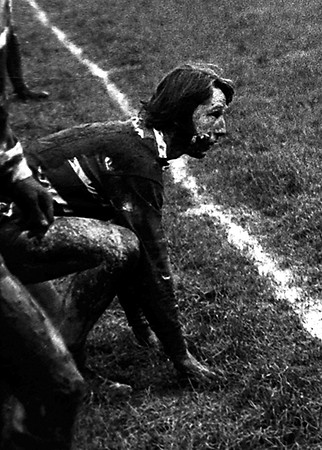 Just after my colleague's departure, legendary Wales and British Lions full-back JPR Williams had to leave the field after an horrific injury thanks to a stamp in the face by a New Zealand prop John Ashworth.
My image (above) shows the aftermath, a bloodied JPR with his cheek torn open. His father (also a doctor) put in 30 stitches, and amazingly, JPR went back onto the field and saw out the rest of the match.
With the light failing fast on a dark damp day in winter, the task of shooting action pictures, even with the film uprated to around 3,200 ASA was almost impossible.
My trusty Canon AE1 and winder fitted with a 70-200 f4 Tokina zoom lens was taking a battering with the constant rain and flying mud.
Back in my home-converted darkroom that afternoon, I was pleased with the results considering the conditions and was rewarded with pictures of the event being published over two weeks in the paper.
The negatives have been amongst my collection ever since and getting that chance to cover the All Blacks at such a young age is something that has stayed with me to this day.
And the match result? Despite Bridgend being one of the best teams in Welsh rugby at the time, they lost 17-6, a score which doesn't reflect the players' valiant efforts.
Whether they're new or old, what are the pictures you most remember? Share your thoughts and experiences in the comments.
]]>
|
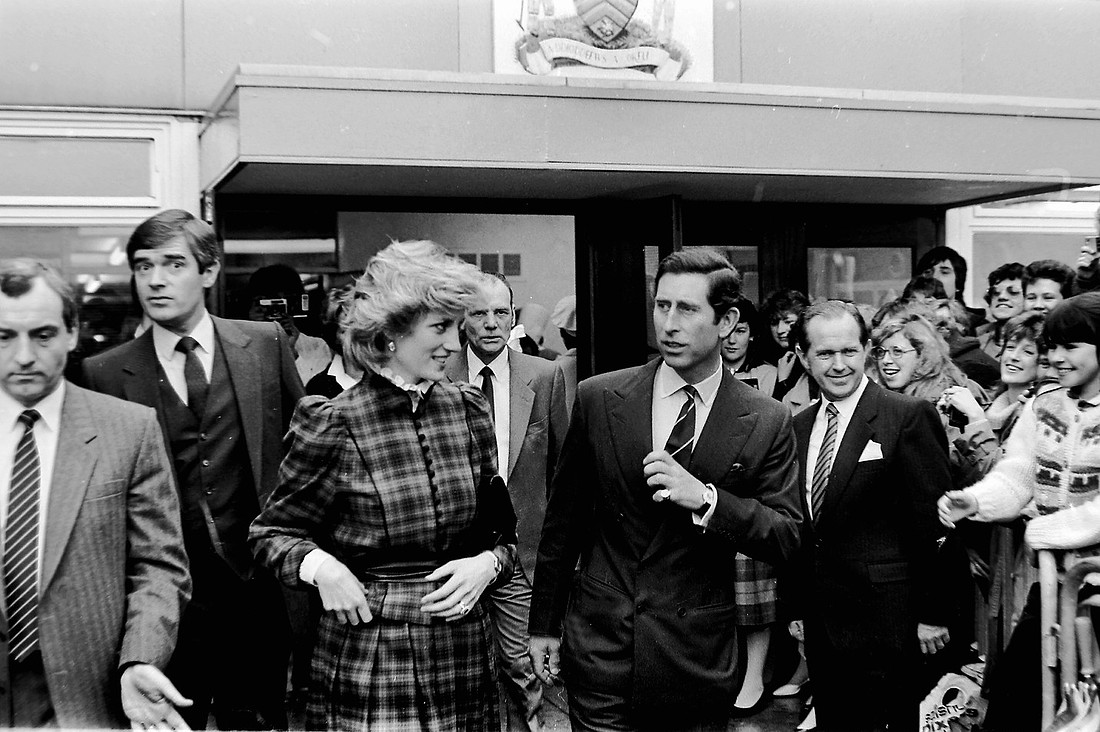
This 1985 picture shows how an official pass put me close to the late Diana, Princess of Wales and HRH Prince Charles as they visited Bridgend, South Wales four years after their marriage. |
I've been scanning the photographers in The Crown Series 5 to see if I can spot myself, but no luck yet. (I'd be looking harrassed, there's a lot of pressure on a royal visit and few things within your control).
As a Cardiff photographer who works throughout Wales and beyond, I've snapped most of the British royals.
When the Netflix drama moved into the late 1970's to the early 90's, it brought back lots of personal and professional memories.
You may be surprised to hear what it's really like to take pictures at a royal visit and enjoy a few of my insider stories and advice about capturing great images of British royalty - whether or not you're a professional photographer.
Read on for my top three stories and tips. Number 3 is one of the biggest lessons I learned. It was a day I photographed the now King Charles and had started out from his home at Highgrove, Gloucestershire (often seen in The Crown, although the Netflix filming location was actually Somerly House in Hampshire).
|
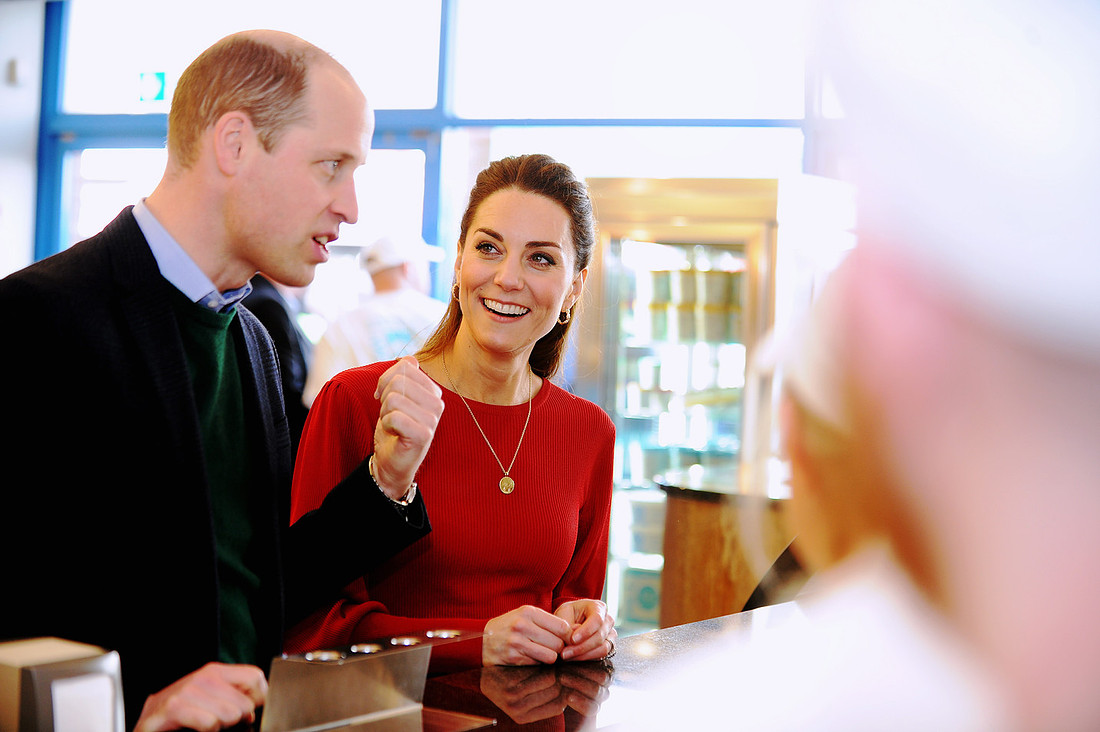
HRH Prince William, Duke of Cambridge and HRH Catherine, Duchess of Cambridge at Joe's Ice Cream Parlour, Mumbles, Swansea in January 2020. I've seen how Prince William is chatty and engaging with members of the public, just like his late mother Diana, Princess of Wales. You can click on any of the pictures on this page to see more in this royal gallery. |
#1 If you don't have an official pass, don't worry too much
You can often come away with even better pictures without being an official photographer, even as a member of the public.
There are two types of passes for professional photographers - a rota pass and a fixed point one (which means what it says, you're fixed to that one spot while the rota pass means you have more freedom of movement at that location).
The organisation you're representing submits its photographers' names in advance and if approved by the Newspaper Society or the palace press office you go along to the place the royals are visiting.
But being one of the offical press photographers on a royal visit has its pros and cons.
There've been many times when I was beaten for picture quality by amateurs or professionals who didn't have a pass.
They simply stood on a step ladder at the back of the crowd and waited for the royal to walk towards the crowd and shake hands with fans.
The photographer on the stepladder would end up with a face-on portrait, one that was sometimes better than the ones the pass-holding photographers could capture because we're usually at the side of the group.
Our images then tend to be side-on and in profile - not showing someone like HRH the Duchess of Cambridge (now the Princess of Wales) or the late Princess Diana to their best effect.
#2 Predict where HRH will go next
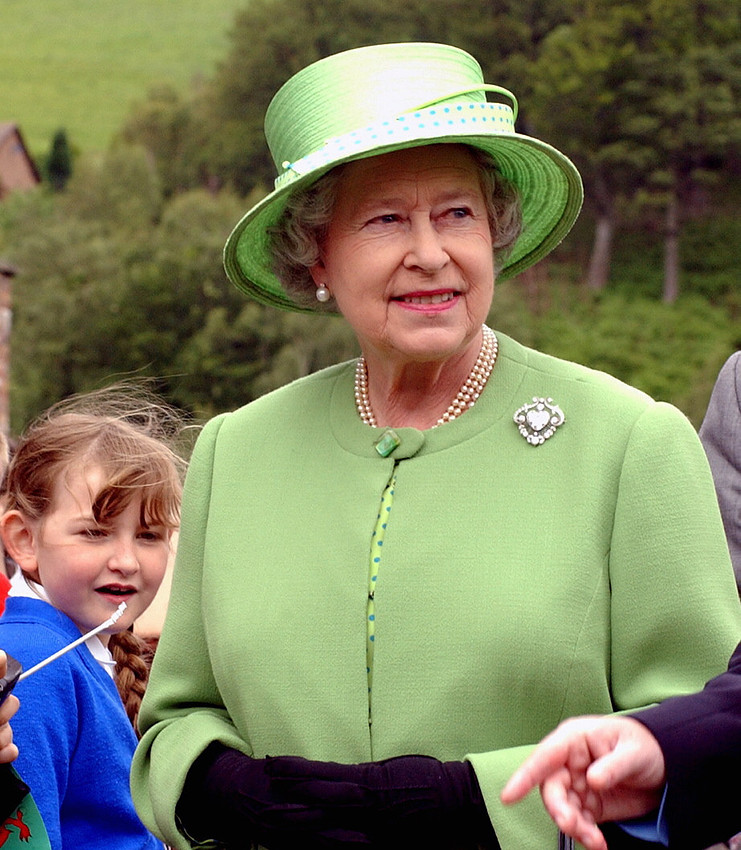
Experience counts for a lot and over the years I learned to work out where the royal visitor would be likely to walk next.
That's always handy because you can arrive a second or two before them and be in position for the best pictures.
A child with flowers or an older person with a big smile is a good bet, and some of the royals will sometimes stand and talk for a while.
Diana, Princess of Wales would be very chatty and her eldest son, Prince William and his wife Kate (the Prince and Princess of Wales) also enjoy talking to the crowd.
Although The Crown is a dramatisation, the scenes of Princess Diana meeting the public on their tour to Australia gave a realistic picture of how she would be with ordinary people - and how popular she was.
3 Always be prepared
I've always taken time to check my photographic equipment, fresh batteries, the right lenses and so on but one royal visit taught me a big lesson I've never forgotten and it was nothing to do with my camera gear.
A professional photographer's bag can weigh a LOT. Mine can be around 20kg (about 44lb).
It was a beautiful, blazing hot summer's day when I set off to photograph the then Prince of Wales, now King Charles, who was out and about in a peaceful Cotswolds forest with an environmental charity, one of the causes closest to his heart.
I'd driven over to Highgrove from South Wales.
The police restricted me from following him into the forest in my car which meant I had to walk over a mile to where the visit was to take place.
Dressed in trousers and a lightweight shirt, this wasn't too much of a problem, although carrying the camera gear too made it a bit of a workout.
The photographs went well, HRH was on fine form and the charity delighted with how it all went.
All I needed to do was trek back to the car, drive home and file the pictures.
The British countryside is stunning and, as I should have known, our weather is unpredictable.
As I walked back, the heavens opened with an unforecast and torrential downpour.
With no wet weather gear in my bag, it was tricky enough trying to keep my camera kit dry and by the time I was back at the car, I was completely drenched down to my underwear.
I had no spare clothes and the only garment in the car was a nasty, sleeveless plasticky photo vest (the kind with lots of pockets, practical but definitely not a fashion item).
Stripping off my shirt, I put the vest on anyway, thinking no-one would see me in it.
With the car heater on full blast, I made my way down the M5 motorway and onto the M4. Then I remembered I needed to stop and pay at the toll booths on what was then the Severn Bridge (since renamed the Prince of Wales bridge and it's now free to cross).
I really don't want to know what was going through the mind of the toll booth operator who had a clear view into the car of this soggy, strangely-dressed motorist. I'm sure he wouldn't have believed I'd just been working with royalty.
And I now always have a lightweight waterproof jacket in my bag and a change of clothes in the car.
I hope you've enjoyed reading this blog - please add your comments and subscribe to see the next one.
]]>